
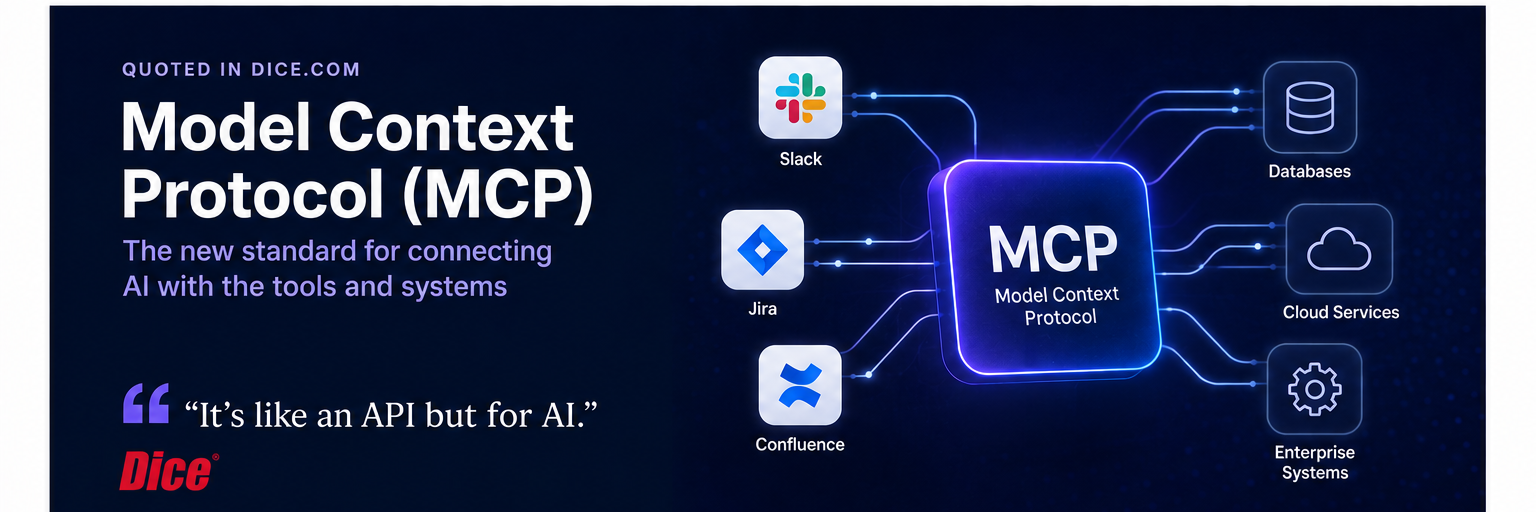
I recently had the pleasure of chatting with Brian Horowitz at Dice.com to share my thoughts on why MCP is a game-changer for developers and organizations alike. The article, titled “Model Context Protocol: What Is It and How to Learn It”, explores how MCP is helping transform AI systems from isolated chat experiences into connected systems that can interact with real-world tools, services, and enterprise platforms.
As part of the article, I shared some thoughts on how MCP is becoming the connective layer between AI agents and enterprise systems:
“It’s like an API but for AI.”
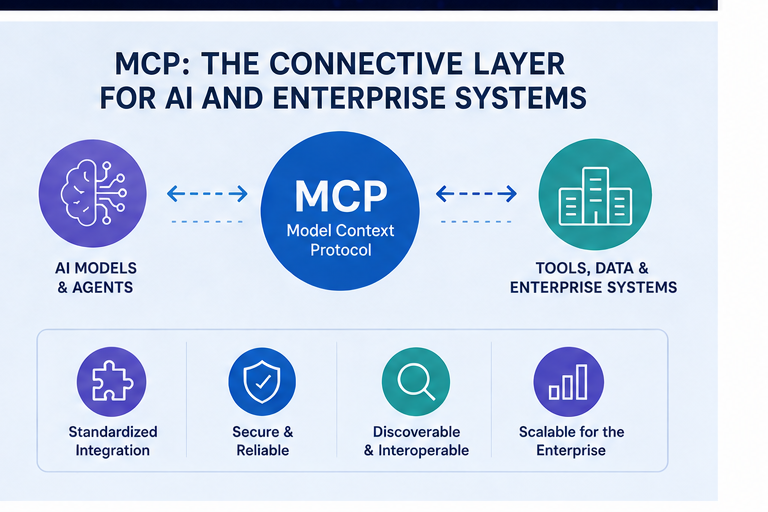
That simple comparison captures why MCP matters so much. Traditional APIs allow applications to communicate with each other. MCP extends this idea into the AI world, enabling AI systems and agents to securely connect to tools, data sources, SaaS platforms, and operational systems in a standardized way.
One of the examples I shared in the article was how MCP enables AI systems to interact directly with enterprise collaboration and workflow platforms.
As I explained in the interview:
“You can connect a platform like ChatGPT to a common tool like Slack. And if you connect MCP to Atlassian Suite, Jira or Confluence, you can prompt AI to perform tasks with those systems.”
This is one of the reasons MCP is generating so much excitement across the industry. Instead of AI being limited to answering questions in isolation, MCP allows AI agents to interact with the actual systems teams use every day.
Imagine prompting an AI assistant to:
- Create or update Jira tickets
- Pull information from Confluence documentation
- Summarize Slack discussions
- Generate status reports across engineering systems
- Trigger workflows and operational tasks
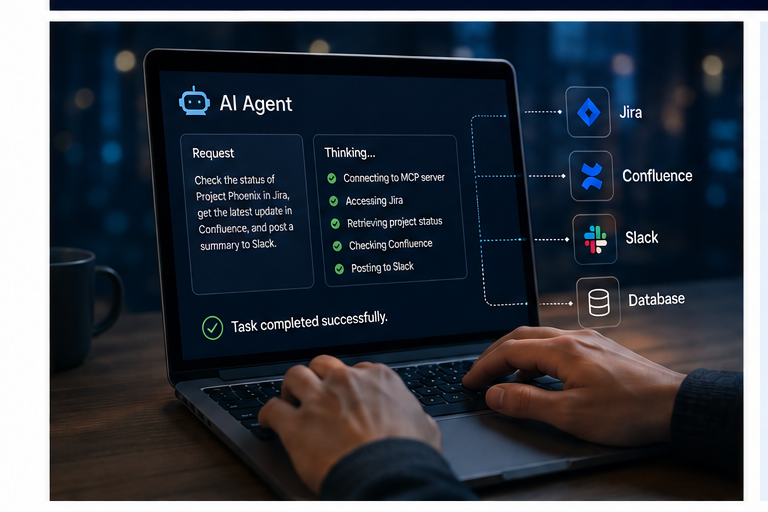
That shift moves AI from being simply conversational into becoming operational.
For engineering organizations, platform teams, and enterprise IT departments, this creates major opportunities to improve productivity, automate repetitive workflows, and build smarter developer experiences across existing toolchains.
At companies operating at scale, especially those managing cloud platforms, Kubernetes environments, DevOps systems, and SaaS operations, MCP has the potential to become a foundational integration layer for enterprise AI workflows.
Why MCP Matters
One of the biggest limitations of AI systems historically has been context and actionability. AI models could generate responses, but they often struggled to interact directly with the systems where actual business work happens.
MCP changes that.
Instead of building custom integrations for every AI interaction, organizations can expose capabilities through MCP servers that AI systems can discover and use dynamically. This creates a more scalable and interoperable ecosystem for AI tooling.
In the article, I discussed examples such as:
- Connecting AI systems to tools like Slack, Jira, and Confluence
- Enabling AI agents to work across DevOps and IT operations workflows
- Allowing healthcare systems to connect AI to scheduling, insurance, and EHR platforms
- Using MCP as the “glue” between AI agents and enterprise systems
This is where things get especially exciting for cloud engineering, platform engineering, and AI infrastructure teams.
MCP and the Future of Enterprise AI
I strongly believe MCP will become foundational infrastructure for enterprise AI adoption.
As organizations move beyond isolated AI chat experiences and toward AI agents that can actually perform work, interoperability becomes critical. MCP helps provide a standard way for AI systems to securely interact with tools and data sources without requiring endless custom integrations.
We are already seeing major momentum across the industry, including adoption and support around MCP-related tooling from companies and ecosystems tied to AI platforms, developer tooling, and cloud services.
For engineering leaders, cloud teams, and developers, this is a space worth paying attention to now, not later.
How to Start Learning MCP
One of the recommendations I shared in the article was to start hands-on:
- Experiment with MCP servers locally
- Use tools like Docker Desktop to simplify setup
- Explore AI agents connected to MCP-enabled systems
- Learn foundational skills in Python and debugging tools like Visual Studio Code
- Focus on understanding how AI agents interact with external systems
The best way to understand MCP is to build with it.
Final Thoughts
It’s an honor to be included alongside other industry voices discussing where AI infrastructure and interoperability are headed next.
We are entering a phase where AI is no longer just about prompts and chat interfaces. The next wave is about connected AI systems, AI agents, and enterprise integration at scale.
And MCP is quickly becoming one of the most important standards enabling that future.
You can read the full article here:
Model Context Protocol: What Is It and How to Learn It