32nd Course Published: Applying GenAI to Planning and Requirements

I’m excited to share that my latest Pluralsight course, Applying GenAI to Planning and Requirements, is now live!

Generative AI is changing how project managers, business analysts, product owners, developers, and other technology professionals approach project planning and requirements gathering. Teams can now use GenAI to organize scattered information, accelerate documentation, identify missing details, and create stronger project artifacts.

However, generating content is only part of the process. Teams also need to validate the output, maintain traceability, involve the right stakeholders, and apply human judgment before AI-generated artifacts are used to guide development.

In this intermediate-level course, I focus on practical and responsible ways to apply GenAI across project planning, requirements gathering, documentation, validation, and governance. The course is approximately 75 minutes and is part of Pluralsight’s Generative AI Across the Software Development Lifecycle learning path.

What You’ll Learn

Modern project teams are expected to move quickly while still producing clear plans, accurate requirements, and documentation that stakeholders can trust.

This course explores how GenAI can help teams meet those expectations without removing people from the decision-making process.

Throughout the course, you’ll learn how to:

  • Generate initial project charters and define project scope
  • Identify assumptions, constraints, dependencies, and scope boundaries
  • Support Agile planning, backlog refinement, estimation, and release planning
  • Create risk registers and develop potential mitigation strategies
  • Transform meeting notes, interviews, emails, and informal briefs into structured requirements
  • Generate user stories, acceptance criteria, and definitions of done
  • Identify missing non-functional requirements related to security, performance, accessibility, and compliance
  • Detect gaps, ambiguities, and contradictions in requirements
  • Generate clarifying questions for stakeholder review
  • Establish human review and stakeholder sign-off workflows
  • Maintain traceability between requirements, backlog items, testing, and supporting evidence
  • Apply governance practices to AI-generated project artifacts

The course is intentionally tool-agnostic, with an emphasis on concepts and transferable practices that can be applied across different GenAI platforms and tools.

Applying GenAI to Project Planning, Scoping, and Risk Management

The first module explores how GenAI can support early project planning activities.

I demonstrate how to use GenAI to create an initial project charter, establish scope boundaries, document assumptions and constraints, and support Agile planning activities.

The module also covers how GenAI can assist with backlog refinement, effort estimation, release planning, risk identification, and mitigation planning.

For example, GenAI can help a project team identify common risks, organize them into a risk register, and propose possible contingency approaches. This can give the team a stronger starting point for planning and stakeholder discussions.

Just as importantly, I discuss the limitations of AI-generated planning artifacts.

GenAI may not understand internal politics, team dynamics, organizational history, available resources, unstated constraints, or business context that was not included in the prompt. Its output may sound complete while still missing important details.

Human judgment remains essential.

Accelerating Requirements Gathering and Documentation

The second module focuses on using GenAI to improve requirements gathering and documentation.

Requirements are often distributed across stakeholder conversations, meeting transcripts, emails, notes, whiteboards, documents, research findings, and informal requests. Important decisions may also exist only as verbal agreements or undocumented assumptions.

GenAI can help organize these inputs and transform them into structured artifacts that a project team can review and refine.

In this section, I show how GenAI can assist with:

  • Requirements workshops
  • Stakeholder discussion prompts
  • Meeting summaries and action items
  • Structured requirements documentation
  • User stories and acceptance criteria
  • Non-functional requirements
  • Definitions of done
  • Gap and ambiguity detection
  • Clarifying questions
  • Audience-adapted requirements documentation

The goal is not to have AI make final product or project decisions.

The goal is to help teams build a stronger starting point, organize information faster, ask better questions, and spend more time validating requirements with stakeholders.

Hands-On Demos with GitHub Copilot App

One of the highlights of the course is the set of practical demos.

I used GitHub Copilot App, OpenAI’s Codex, and GitHub Projects througout the demos so that you have an example with real tools you can start using today. In one of the demos GitHub Copilot App was used to move from unstructured project inputs to usable planning and requirements artifacts in GitHub Project. I show learners how GenAI can move beyond producing isolated text and become part of a real project workflow.

Across the demos, I show how to use GitHub Copilot to:

Read more

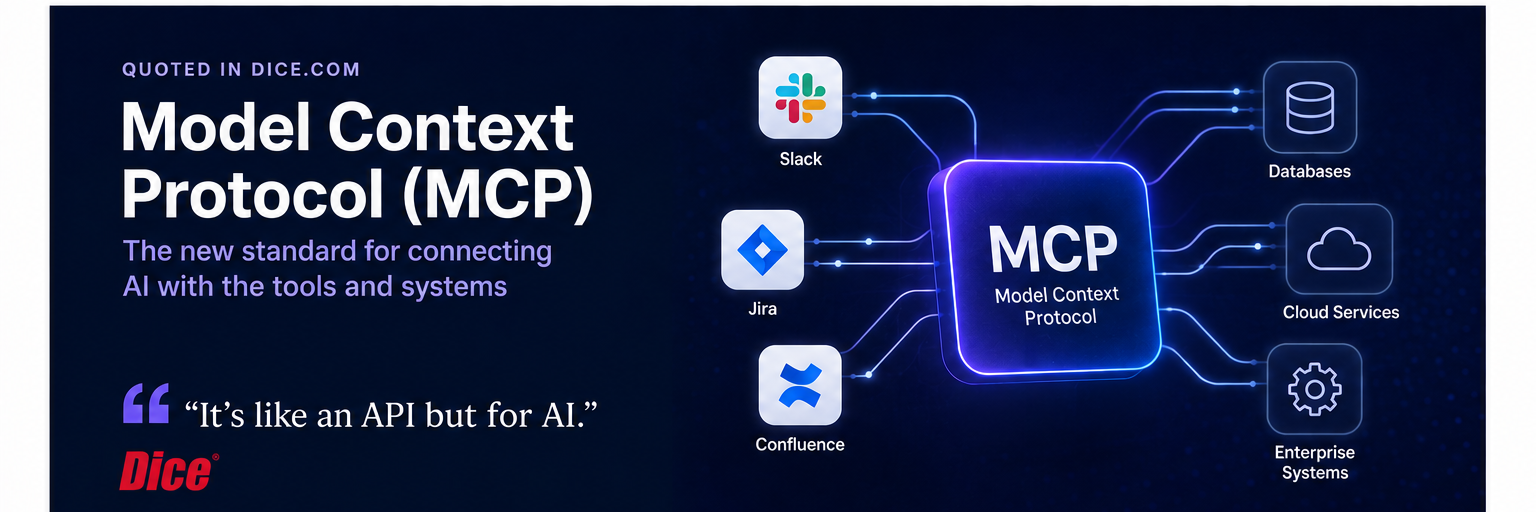
Quoted in Dice.com Article on Model Context Protocol: What Is It and How to Learn It

I recently had the pleasure of chatting with Brian Horowitz at Dice.com to share my thoughts on why MCP is a game-changer for developers and organizations alike. The article, titled “Model Context Protocol: What Is It and How to Learn It”, explores how MCP is helping transform AI systems from isolated chat experiences into connected systems that can interact with real-world tools, services, and enterprise platforms.

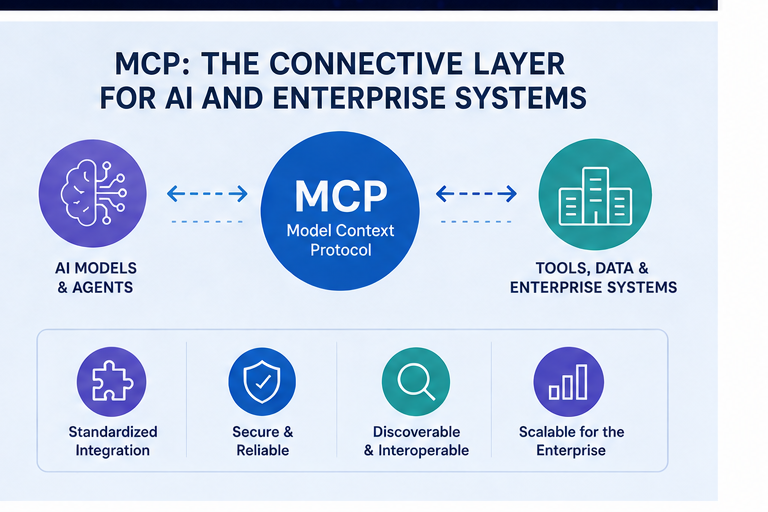
As part of the article, I shared some thoughts on how MCP is becoming the connective layer between AI agents and enterprise systems:

“It’s like an API but for AI.”

That simple comparison captures why MCP matters so much. Traditional APIs allow applications to communicate with each other. MCP extends this idea into the AI world, enabling AI systems and agents to securely connect to tools, data sources, SaaS platforms, and operational systems in a standardized way.

One of the examples I shared in the article was how MCP enables AI systems to interact directly with enterprise collaboration and workflow platforms.

As I explained in the interview:

“You can connect a platform like ChatGPT to a common tool like Slack. And if you connect MCP to Atlassian Suite, Jira or Confluence, you can prompt AI to perform tasks with those systems.”

This is one of the reasons MCP is generating so much excitement across the industry. Instead of AI being limited to answering questions in isolation, MCP allows AI agents to interact with the actual systems teams use every day.

Imagine prompting an AI assistant to:

  • Create or update Jira tickets
  • Pull information from Confluence documentation
  • Summarize Slack discussions
  • Generate status reports across engineering systems
  • Trigger workflows and operational tasks
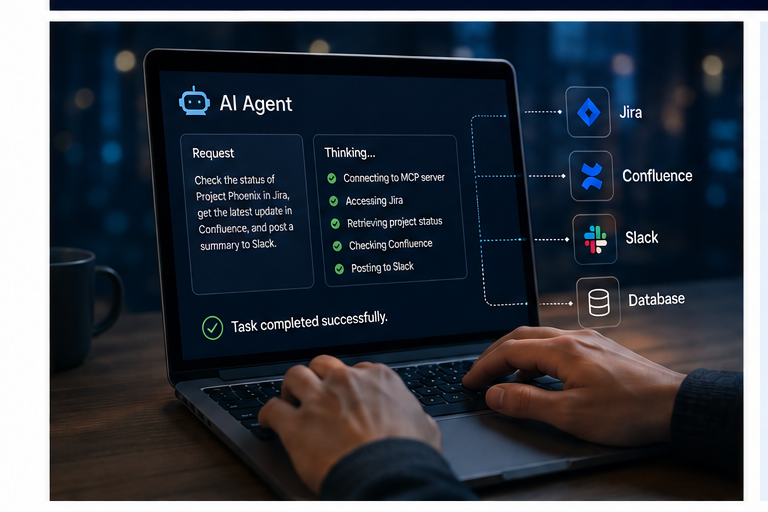
That shift moves AI from being simply conversational into becoming operational.

For engineering organizations, platform teams, and enterprise IT departments, this creates major opportunities to improve productivity, automate repetitive workflows, and build smarter developer experiences across existing toolchains.

At companies operating at scale, especially those managing cloud platforms, Kubernetes environments, DevOps systems, and SaaS operations, MCP has the potential to become a foundational integration layer for enterprise AI workflows.

Why MCP Matters

One of the biggest limitations of AI systems historically has been context and actionability. AI models could generate responses, but they often struggled to interact directly with the systems where actual business work happens.

MCP changes that.

Instead of building custom integrations for every AI interaction, organizations can expose capabilities through MCP servers that AI systems can discover and use dynamically. This creates a more scalable and interoperable ecosystem for AI tooling.

In the article, I discussed examples such as:

  • Connecting AI systems to tools like Slack, Jira, and Confluence
  • Enabling AI agents to work across DevOps and IT operations workflows
  • Allowing healthcare systems to connect AI to scheduling, insurance, and EHR platforms
  • Using MCP as the “glue” between AI agents and enterprise systems

This is where things get especially exciting for cloud engineering, platform engineering, and AI infrastructure teams.

MCP and the Future of Enterprise AI

I strongly believe MCP will become foundational infrastructure for enterprise AI adoption.

As organizations move beyond isolated AI chat experiences and toward AI agents that can actually perform work, interoperability becomes critical. MCP helps provide a standard way for AI systems to securely interact with tools and data sources without requiring endless custom integrations.

We are already seeing major momentum across the industry, including adoption and support around MCP-related tooling from companies and ecosystems tied to AI platforms, developer tooling, and cloud services.

For engineering leaders, cloud teams, and developers, this is a space worth paying attention to now, not later.
How to Start Learning MCP

One of the recommendations I shared in the article was to start hands-on:

  • Experiment with MCP servers locally
  • Use tools like Docker Desktop to simplify setup
  • Explore AI agents connected to MCP-enabled systems
  • Learn foundational skills in Python and debugging tools like Visual Studio Code
  • Focus on understanding how AI agents interact with external systems

The best way to understand MCP is to build with it.

Final Thoughts

It’s an honor to be included alongside other industry voices discussing where AI infrastructure and interoperability are headed next.

We are entering a phase where AI is no longer just about prompts and chat interfaces. The next wave is about connected AI systems, AI agents, and enterprise integration at scale.

And MCP is quickly becoming one of the most important standards enabling that future.

You can read the full article here:
Model Context Protocol: What Is It and How to Learn It

Read more

24th and 25th Pluralsight Courses Published

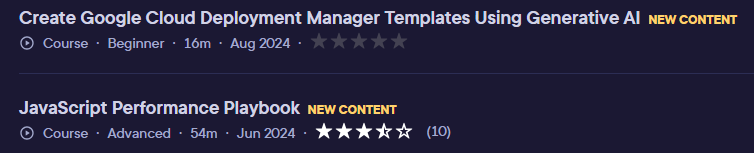
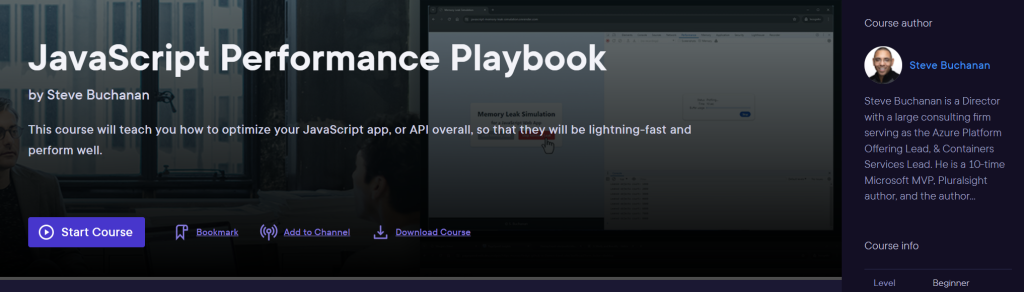
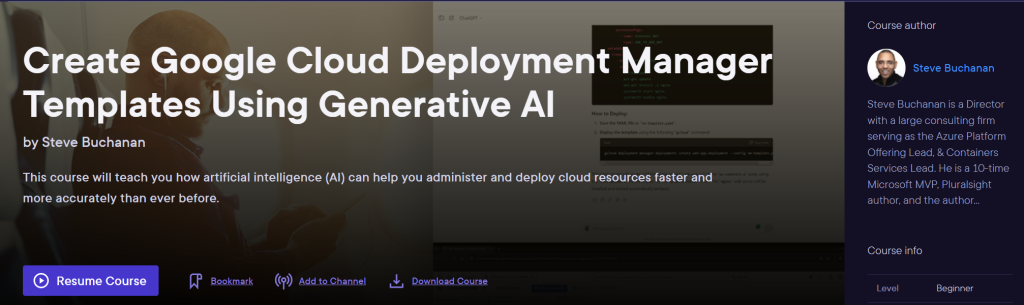
I have been so busy in 2024 that I didnt have a chance to post about my 24th and 25th Pluralsight courses. So I am a little late posting this but I am excited that my 24th course “JavaScript Performance Playbook” and my 25th course “Create Google Cloud Deployment Manager Templates Using Generative AI” have both published on the Pluralsight platform!

You can find both courses here:

JavaScript Performance Playbook

This course will teach you how to optimize your JavaScript app, or API overall, so that they will be lightning-fast and perform well.

https://app.pluralsight.com/library/courses/javascript-performance-playbook

&

Create Google Cloud Deployment Manager Templates Using Generative AI

This course will teach you how artificial intelligence (AI) can help you administer and deploy cloud resources faster and more accurately than ever before.

https://app.pluralsight.com/library/courses/create-google-cloud-deployment-manager-templates-generative-ai

I hope you find value in these new courses. Be sure to follow my profile on Pluralsight so you will be notified as I release new courses

Here is the link to my Pluralsight profile to follow me:

https://www.pluralsight.com/authors/steve-buchanan

Read more